Good news first: there are only a handful of Self Assessment deadlines, and they fall on the same dates every year. The one that matters most right now is 31 January 2027. That is when your online tax return for the 2025/26 tax year is due, and when you pay what you owe.
Miss it and HMRC charges £100 straight away, even if you have no tax to pay. So here is every date, what is due on it, and what to do if one has already slipped past you.
Filing for the first time? As an accountant, my advice is don’t let fear stop you. The trick is to start as soon as you can, take your time and stay calm. There are a lot of boxes on the form, but most of them probably won’t apply to you.
Self Assessment deadlines at a glance
These are the dates for the 2025/26 tax year, which ran from 6 April 2025 to 5 April 2026.
| Date | What is due |
|---|---|
| 5 October 2026 | Tell HMRC you need to send a tax return, if this is your first one |
| 31 October 2026 | Paper tax return |
| 30 December 2026 | Online tax return, if you have a job too and want HMRC to collect the tax through your tax code |
| 31 January 2027 | Online tax return, your tax bill for 2025/26, and your first payment on account for 2026/27 |
| 31 July 2027 | Second payment on account for 2026/27 |
The first two have passed. If you missed one, keep reading: it is usually fixable.
Each deadline explained
5 October 2026: register for Self Assessment
If you started working for yourself in the 2025/26 tax year and have never sent a tax return, you had until 5 October 2026 to tell HMRC. Once you register, HMRC sends your Unique Taxpayer Reference (UTR), the 10-digit number you need to file.
Already registered from an earlier year? You don’t register again. Just send your return.
Read: How to register as self-employed and What is a UTR number?
Missed the 5 October deadline? Do this
Register today. HMRC still accepts late registrations, and here is what happens next:
- HMRC writes to you with your UTR and a deadline for your return. That deadline is three months from the date on its letter or email.
- Your tax is still due by 31 January 2027. That date does not move.
- If you pay everything you owe by 31 January, you can avoid the penalty for registering late. HMRC calls it a “failure to notify” penalty, and it is based on tax still unpaid after that date.
So the fix is simple: register now, and put money aside for 31 January even if your return isn’t finished.

Join the Club — it’s completely free
Members get handpicked deals and discounts on the tools, services and everyday essentials UK self-employed people actually use. Free to join, no catch.
31 October 2026: paper tax returns
Paper returns for 2025/26 had to reach HMRC by 31 October 2026. If you missed it, file online instead. You get until 31 January 2027, and HMRC works out your bill for you.
30 December 2026: paying through your tax code
This one only applies if you have a job as well as your business. File online by 30 December and HMRC can collect what you owe through your tax code over the following year, instead of one payment in January. It only works if you owe less than £3,000.
If you’d rather pay in one go, ignore this date and file by 31 January.
31 January 2027: the big one
By 11:59pm on 31 January 2027, three things are due:
- Your tax return for 6 April 2025 to 5 April 2026.
- Your tax bill: Income Tax and National Insurance on your 2025/26 profit.
- Your first payment on account for 2026/27, if you have to make them. It is half of this year’s bill, paid in advance towards next year’s.
That third one catches people in their first year. Your January payment can be one and a half times your tax bill. Our guide to payments on account explains who pays them and how to reduce them.
You don’t have to wait until January. You have been able to file since 6 April 2026, and filing early doesn’t mean paying early. It just means you know the number.
31 July 2027: second payment on account
The other half of your advance payment for 2026/27 is due on 31 July 2027. If your income has dropped, you can ask HMRC to reduce your payments on account. Only do it if you’re confident: if you reduce them too far, you pay interest on the difference.
What happens if you miss a deadline
If your tax return is late
| How late | Penalty |
|---|---|
| 1 day | £100 |
| After 3 months | £10 a day, up to £900 |
| After 6 months | 5% of the tax due or £300, whichever is greater |
| After 12 months | Another 5% or £300, whichever is greater |
The £100 applies even if you owe nothing.
If your payment is late
HMRC charges 5% of the unpaid tax at 30 days, again at 6 months and again at 12 months. Interest is added on top from the day after the deadline.
If you had a good reason, such as a serious illness or a bereavement, you can appeal against a penalty.
If you can’t pay
File your return anyway. A late return and a late payment are two separate penalties, so filing on time halves the problem. Then set up a payment plan with HMRC to pay in monthly instalments. You can do it online: see GOV.UK: pay your tax bill in instalments.
If you joined Making Tax Digital in April 2026
Making Tax Digital for Income Tax started on 6 April 2026 for sole traders and landlords whose income from self-employment and property was over £50,000 on their 2024/25 tax return. That is income before expenses.
Two things to know this January:
- You still send a normal tax return for 2025/26 by 31 January 2027. Making Tax Digital starts with the 2026/27 tax year.
- Your payment dates are the same as everyone else’s: 31 January and 31 July.
Your quarterly updates for 2026/27 are due on these dates. Each one covers the year so far.
| Period covered | Deadline |
|---|---|
| 6 April to 5 July 2026 | 7 August 2026 |
| 6 April to 5 October 2026 | 7 November 2026 |
| 6 April 2026 to 5 January 2027 | 7 February 2027 |
| 6 April 2026 to 5 April 2027 | 7 May 2027 |
Your tax return for 2026/27, sent through your software, is then due by 31 January 2028.
HMRC is not giving penalty points for late quarterly updates in 2026/27. You still have to send all four before you can send your tax return, and a late tax return does get a point.
Not in yet? The threshold drops to £30,000 from 6 April 2027 and £20,000 from 6 April 2028. Read: Making Tax Digital for sole traders.
What comes next: dates for your 2026/27 tax return
The dates repeat every year, so you can put these in your calendar now.
- 6 April 2027: you can start filing your 2026/27 return.
- 5 October 2027: register, if 2026/27 was your first year.
- 31 October 2027: paper returns.
- 31 January 2028: online return and payment.
How to never miss a deadline
Save this picture to your phone so the dates are always to hand.
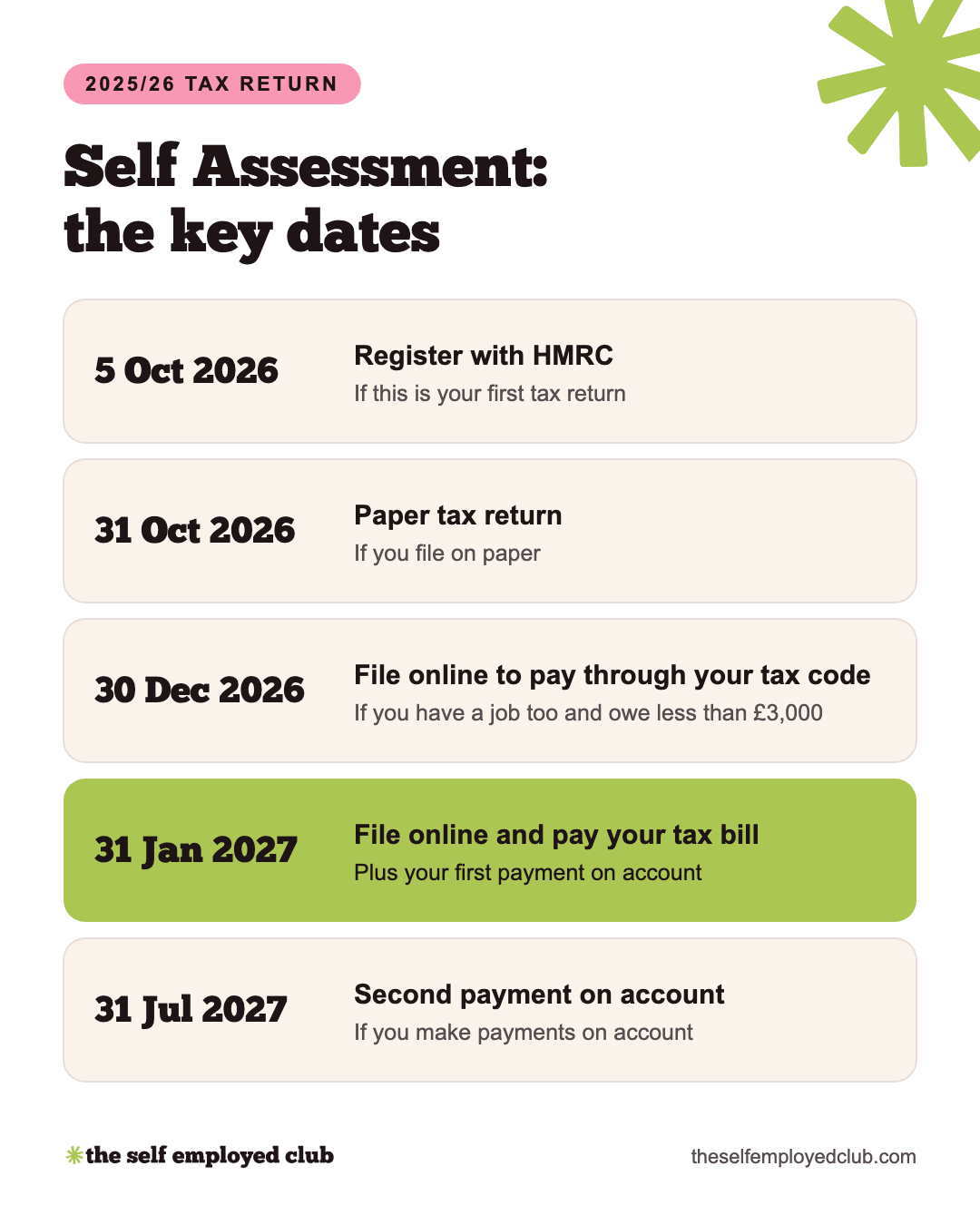
- Put the dates in your calendar today. 31 January and 31 July, repeating every year.
- File early. File in the spring or summer and you know your bill months before it’s due.
- Put tax aside as you go. Move a share of every payment into a separate pot the day it lands.
- Get your paperwork together first. Our Self Assessment checklist lists everything to gather, with a free one-page PDF.
- Use accounting software. It keeps your income and expenses in one place all year, so January is a job of checking, not hunting for receipts. See our best apps for sole traders.
Members of The Self Employed Club get 90% off Xero for 6 months: Making Tax Digital compatible accounting software that keeps your records ready all year round. Grab the deal →
Read next: Sole trader tax return: how to fill in your Self Assessment and Self-employed tax: how it works.
FAQs
When is the Self Assessment deadline?
31 January 2027 for online tax returns for the 2025/26 tax year. Any tax you owe is due the same day. Paper returns were due by 31 October 2026.
What happens if I miss the 31 January deadline?
You get a £100 penalty straight away, even if you have no tax to pay. After 3 months it is £10 a day, up to £900, with more penalties at 6 and 12 months. File as soon as you can to stop it growing.
Can I file my Self Assessment early?
Yes. You can file any time from 6 April after the tax year ends. Filing early doesn’t change when you pay.
What is the deadline to register for Self Assessment?
5 October after the end of the tax year you started in. For 2025/26 that was 5 October 2026. If you missed it, register now and pay what you owe by 31 January 2027.
What is a payment on account?
An advance payment towards next year’s tax bill. There are two a year, each half of your last bill, due on 31 January and 31 July. You make them if your last bill was over £1,000, unless most of your tax was already taken at source.
Do I need to send a tax return every year?
Yes, once you’re registered, even if you made a loss or very little. If you stop being self-employed, tell HMRC so it can take you out of Self Assessment.
What if I can’t afford to pay my tax bill?
File your return on time, then set up a payment plan with HMRC to pay monthly. You can do this online through GOV.UK.
Does the deadline change if I’m in Making Tax Digital?
The payment dates don’t change. You send four quarterly updates during the year, and your tax return is still due by 31 January after the tax year ends. For 2026/27, the first Making Tax Digital year, that is 31 January 2028.
Want to Read More About Self-Employed Tax & Self Assessment?
If you’ve enjoyed this post you may like to read more about self-employed tax & self assessment. Here are some of my most popular blog posts on this topic…
- Making Tax Digital for Sole Traders: Key Dates, Rules & How to Get Ready
- Self-Employed Tax: How It Works and What You Need to Know
- How to Register as Self-Employed in the UK: A Step-by-Step Guide
- How to Become Self-Employed in the UK: A Step-by-Step Guide
- Sole Trader Tax Return: How to Fill In Your Self Assessment
- Deals and Discounts for Sole Traders: What’s Available in 2026

About the Author
Anita Forrest
Chief Deal Hunter
Anita is a Chartered Accountant, self-employed business owner and the person behind The Self Employed Club. She created the Club to help UK self-employed people spend less and keep more of what they earn, by bringing useful deals for their business and everyday life together in one place.
She writes about the things you actually need to know when you work for yourself, in the way she would want someone to explain them to her - clearly, simply and without the usual business waffle.
Join the Club — it's completely free
Members get handpicked deals and discounts on the tools, services and everyday essentials UK self-employed people actually use. Free to join, no catch.