If you’ve just filed your first Self Assessment return and the bill is far bigger than you expected, a payment on account is usually why. It’s HMRC asking you to pay part of next year’s tax in advance, and it catches out almost every newly self-employed person I’ve worked with as a Chartered Accountant. Here’s how payments on account work, how HMRC calculates them, and what you can do if they’re too high.
Table of Contents
What is a payment on account?
A payment on account is an advance payment towards your next tax bill. Instead of paying all your tax for a year in one go after the tax year ends, HMRC splits it into two instalments paid in advance, along with a final payment (or refund) once you file your tax return for that year.
Payments on account cover your Income Tax and, if you’re self-employed, your Class 4 National Insurance. They don’t cover capital gains tax or student loan repayments: those are paid with the balancing payment (more on that below).
When are HMRC payments on account due?
There are two each year:
- First payment on account: by midnight on 31 January, during the tax year.
- Second payment on account: by midnight on 31 July, after the tax year ends.
Then, by the following 31 January, you pay a balancing payment if your actual bill turns out higher than the payments on account you’ve made, or you can claim money back if you’ve overpaid.
How is a tax payment on account calculated?
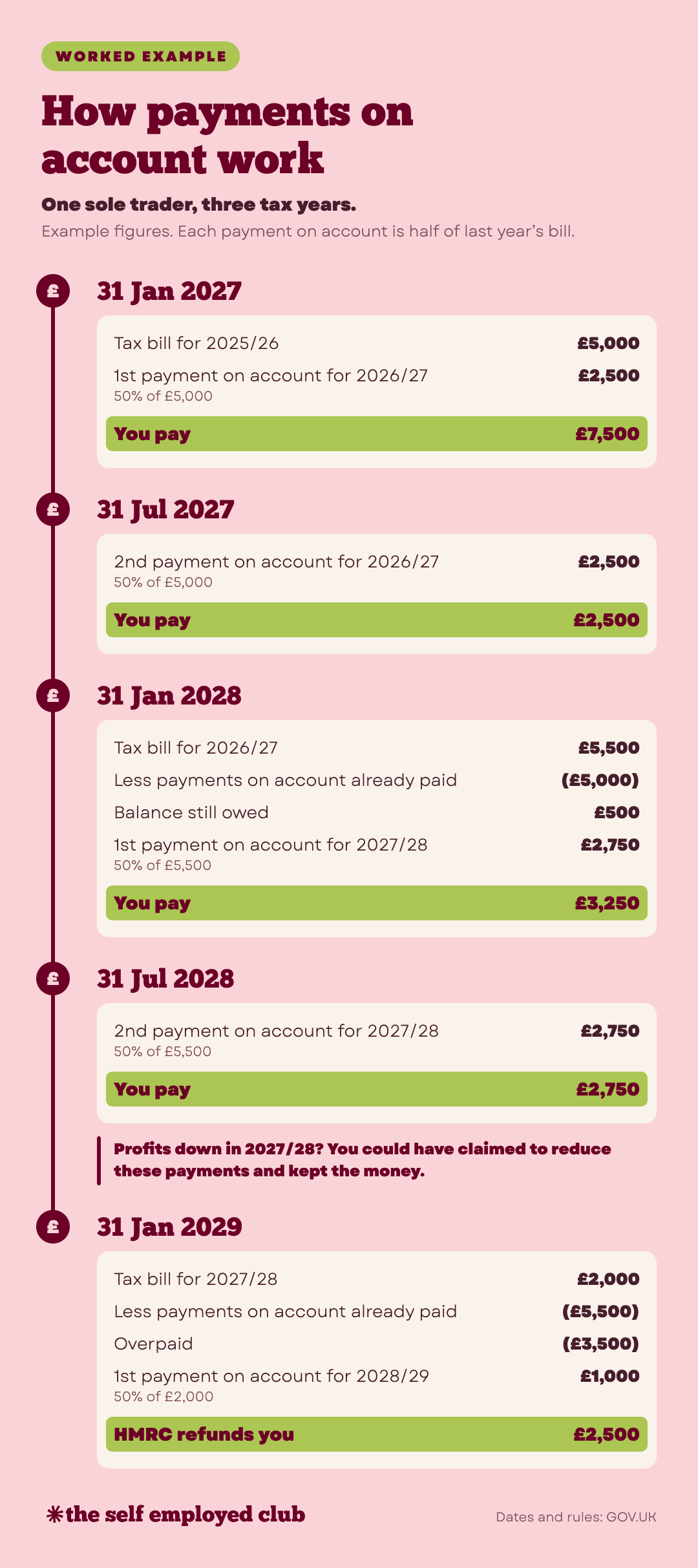
Each payment on account is normally half of the tax you owed for the previous tax year (the tax year runs from 6 April to 5 April). HMRC assumes this year will look like last year.
So if your Self Assessment bill for last year was £3,000, you’d pay £1,500 on 31 January and £1,500 on 31 July towards this year.
Our sole trader tax calculator shows your payments on account alongside your tax bill.
Do I have to make payments on account?
Not always. You don’t have to make them if either:
- your last Self Assessment bill was less than £1,000, or
- you paid more than 80% of last year’s tax another way, for example through PAYE on a job or your tax code.
This is why lots of people with a small side hustle alongside a job never see them.
Why your first January tax bill is so big
This is the bit that hurts. In your first year of paying through Self Assessment, you pay last year’s full bill plus the first payment on account for this year, all on the same 31 January.
Using GOV.UK’s own example: if your bill for 2025 to 2026 is £3,000 and you haven’t made payments on account before, by 31 January 2027 you’ll pay:
- £3,000 for 2025 to 2026, plus
- £1,500 first payment on account for 2026 to 2027
- = £4,500, then another £1,500 on 31 July 2027.
That’s 150% of your bill in one go. From the second year it evens out: each January you pay any balancing payment for the year just gone plus the first payment on account for the current year.
What I tell new sole traders: put money aside from every invoice from day one. Our guide to self-employed tax explains what you’ll pay.
Does Making Tax Digital change payments on account?
No. Making Tax Digital for Income Tax changes how you keep records and report to HMRC, not when you pay. If you’re a sole trader or landlord with qualifying income over £50,000 (based on your 2024 to 2025 tax return), you’ve had to use it since 6 April 2026. The threshold drops to £30,000 from April 2027 and £20,000 from April 2028.
Under Making Tax Digital you keep digital records and send quarterly updates through software, by 7 August, 7 November, 7 February and 7 May. These are summaries of your income and expenses, not tax payments. You still file an end-of-year tax return by 31 January, and HMRC says the new system won’t change the way you pay Income Tax or the dates you pay it. So your payments on account are still due on 31 January and 31 July, with any balancing payment on the following 31 January.
The upside is that your quarterly updates give you a running estimate of your tax bill, so you’ll spot early if your payments on account look too high or too low. Read our guide to Making Tax Digital for the self-employed.
How to reduce payments on account
If you know your income is going to drop this year, for example you’ve had a quieter year, gone part-time or taken parental leave, you can ask HMRC to reduce your payments on account.
- Online: sign in to your HMRC online account, choose your latest return, then Reduce payments on account. You’ll need to say how much you expect to owe.
- By post: send form SA303 to HMRC.
Be realistic. If you reduce them and your bill turns out higher, HMRC charges interest on the difference. Only reduce them when you have a good reason to expect lower profits, not just to ease cash flow.
What if I’ve paid too much?
If your profits fall and your payments on account come to more than your actual bill, the overpayment is set against what you owe next, or you can claim a refund. You can check what you’ve paid by signing in and choosing View statements on your latest return.

Join the Club — it’s completely free
Members get handpicked deals and discounts on the tools, services and everyday essentials UK self-employed people actually use. Free to join, no catch.
How to make payments on account easier
If you’re about to file, our Self Assessment checklist lists everything to gather first, including the payments on account you’ve already made.
- Know your numbers early. Keeping your books up to date during the year means you can see your tax bill coming and decide early whether to reduce your payments on account. If you’re under Making Tax Digital you’ll be doing this every quarter anyway. Accounting software like Xero shows an estimate as you go: see the Xero deal for Club members.
- File early. You don’t have to wait until January: filing in the summer or autumn tells you exactly what’s due on 31 January. See our guide to filing your Self Assessment tax return and the Self Assessment deadlines.
- Pay in instalments. HMRC’s online account lets you make payments towards your bill ahead of the deadline, which can make 31 January less of a shock.
If you’ve just registered and are waiting for your UTR, read what a UTR number is and how to get one first.
FAQs
What does payment on account mean?
It’s an advance payment towards your next tax bill. HMRC usually asks for two, each worth half of last year’s bill, on 31 January and 31 July.
Do I pay payments on account in my first year of self-employment?
Usually not until after your first return. The first 31 January after your first return is when they start, and that’s why the bill is so large: last year’s tax plus half of the next year’s in advance. If your bill is under £1,000, you won’t have to make them.
Can I reduce my payments on account?
Yes, online through your HMRC account or with form SA303, if you expect your tax bill to be lower. If it turns out higher, you’ll pay interest on the shortfall.
Do payments on account include National Insurance?
Yes, Class 4 National Insurance is included if you’re self-employed. Student loan repayments and capital gains tax are not: they’re paid with the balancing payment.
What happens if I can’t pay my payment on account?
Contact HMRC as soon as possible. Late payments are charged interest, and HMRC may agree a payment plan (Time to Pay) if you can’t pay in full.
Information checked against GOV.UK on 6 November 2026. This is general information, not personal tax advice. If you’re unsure what you owe, speak to an accountant.
Affiliate link: the Club may earn a commission if you sign up through the Xero link, at no extra cost to you.
Want to Read More About Self-Employed Tax & Self Assessment?
More guides like this are in Money & Tax. Here are some of the most popular:

About the Author
Anita Forrest
Chief Deal Hunter
Anita is a Chartered Accountant, self-employed business owner and the person behind The Self Employed Club. She created the Club to help UK self-employed people spend less and keep more of what they earn, by bringing useful deals for their business and everyday life together in one place.
She writes about the things you actually need to know when you work for yourself, in the way she would want someone to explain them to her - clearly, simply and without the usual business waffle.
Join the Club — it's completely free
Members get handpicked deals and discounts on the tools, services and everyday essentials UK self-employed people actually use. Free to join, no catch.