Good news: yes, you can claim your mobile phone as a business expense. If you’re self-employed and you use it for work, the business part of the cost is allowable. That lowers your profit, which means less tax to pay.
The catch is the word “part”. If you’re like most of us, one phone does everything: client calls, the school WhatsApp group and far too much scrolling. HMRC only lets you claim the share that’s for your business.
Don’t worry, it’s simpler than it sounds. Here’s how to work out your share, what to do about the handset, and what to keep in case HMRC ever asks.
As an accountant, I see people forgetting to claim anything at all, usually because the phone bill comes out of their personal bank account and never makes it onto their tax return. Get a business account and a business phone, keep it all in one place, and you won’t forget to get your claim in.
The short answer
- One phone for work and personal use: claim the business share of the bill.
- A separate phone or SIM used only for work: claim the whole cost.
- The handset: claim the business share of what you paid for it.
- Using the £1,000 trading allowance: you can’t claim phone costs as well.
What HMRC says about mobile phone expenses
GOV.UK lists “phone, mobile, fax and internet bills” among the office costs you can claim when you’re self-employed. It also says you can’t claim for any non-business use of your phone.
HMRC even gives an example. Your mobile bills for the year come to £200. £130 of that is personal calls and £70 is business calls. You can claim £70.
Lovely and neat, but it comes from the days of paying per call. These days you probably pay one monthly price for unlimited calls and a chunk of data, so there’s no list of business calls to add up. You need another way to split the bill.
How to split one phone between work and personal use
HMRC asks for a “reasonable method”. It doesn’t tell you which one, and for all-inclusive contracts its own guidance tells tax inspectors to be flexible. So you don’t need a spreadsheet of every call. You need a sensible way of measuring your use, applied fairly, and a note of how you did it.
Here’s an easy way to do it.
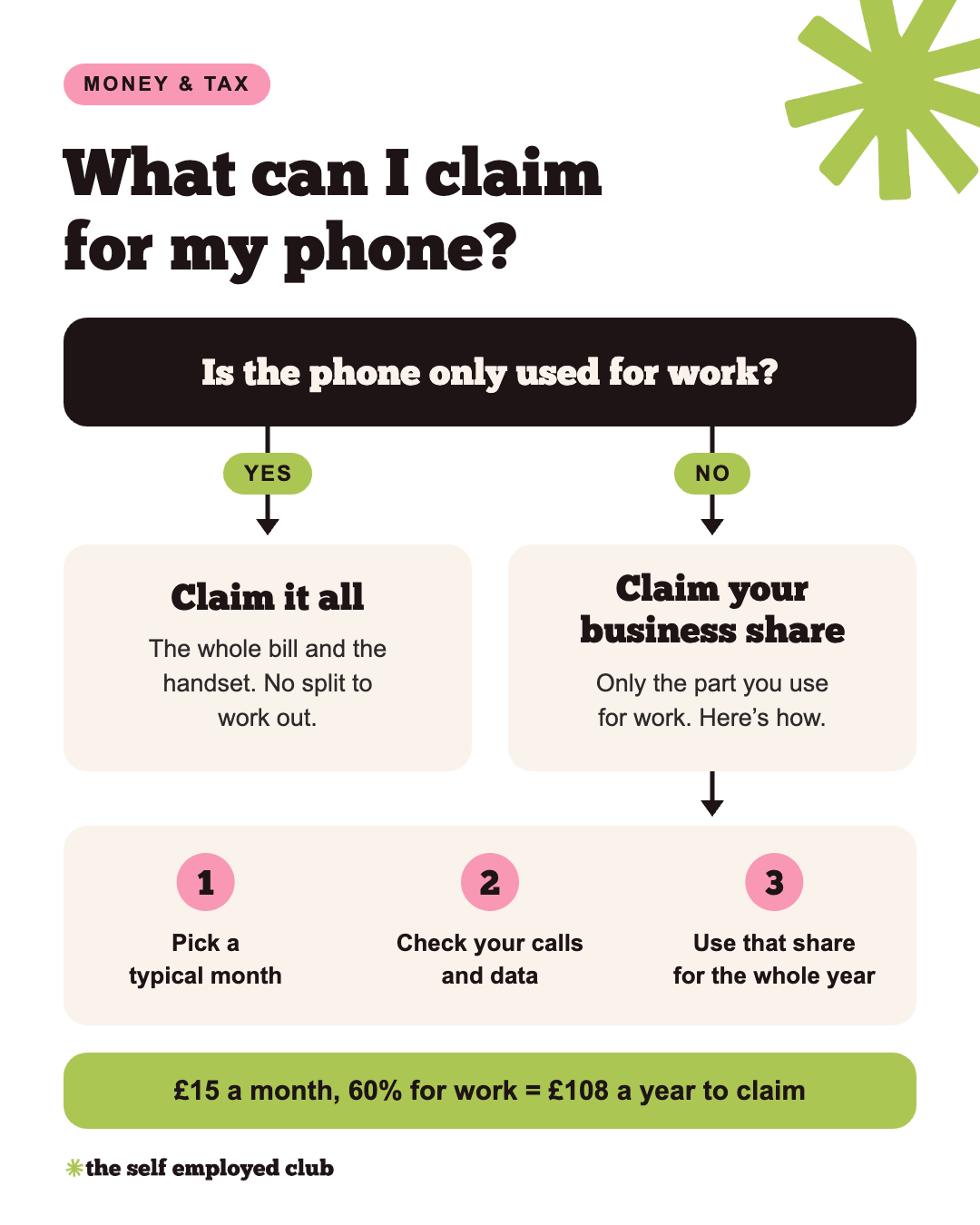
- Pick a typical month. Not your quietest, not your busiest.
- Look at how you used your phone. Your itemised bill or your phone’s own usage screen shows your calls, and most phones show data use by app.
- Work out your business share. If around 60% of your calls and data that month were for work, your business share is 60%.
- Apply that share to the year’s bills.
- Jot down how you got there, and look at it again if the way you work changes.
Example: one phone, used for both
Priya is a freelance graphic designer. Her SIM-only plan costs £15 a month, which is £180 a year. She checks a typical month and finds about 60% of her use is for work: client calls, emails and sending files on the go.
She claims 60% of £180, which is £108.
A separate phone or SIM just for work
If you have a phone or a SIM that you only use for your business, life gets easier. You can claim the whole cost, with no split to work out.
HMRC’s guidance accepts that where private use isn’t significant, you can claim the full cost. So the odd personal call won’t undo it. Using it as your everyday phone will.
This is why lots of self-employed people run a second, low-cost SIM for work. It keeps your records tidy, it gives you a business number to put on your website, and you can switch it off at the weekend. That last one might be the best bit.
If you’re looking for one, Lebara Mobile has SIM-only plans from £5 a month, with no contract on its 30-day plans and no credit check. You can also compare O2 and Lyca Mobile in the Club. Lebara and Lyca don’t run a credit check; here’s our guide to no credit check SIM-only deals.
Can I claim the cost of the phone itself?
Yes, on the same basis: the business share.
How you claim it depends on how you do your accounts.
- Cash basis. This is now the standard method for sole traders, so it’s probably you. You claim the handset as a normal expense in the year you pay for it.
- Traditional accounting. You claim it through capital allowances instead. For most sole traders the result is the same: the cost comes off your profit in the year you buy it.
Example: buying a handset
Tom is a self-employed plumber. He buys a new phone outright for £600 and uses it 70% for work. He claims 70% of £600, which is £420.
What if the handset is part of my monthly contract?
Even easier. Your monthly payment covers the phone and the airtime together, so there’s nothing to separate out. Just claim the business share of each monthly payment.
What you can’t claim
- The personal share of your bill or your handset.
- Phones or SIMs for your partner or children, even if they’re on your account.
- Phone costs on top of the £1,000 trading allowance. It’s one or the other. If your total expenses for the year are under £1,000, the allowance usually gives you more.
If you’re VAT registered
You can usually reclaim the VAT on the business share of your phone costs as well. Use the same split you use for your accounts, and keep the VAT invoices.
What records to keep
Nothing complicated:
- Your phone bills, or the bank statements showing the payments.
- The receipt for the handset, if you bought one.
- A short note of how you worked out your business share, and the month you based it on.
Keep them for at least 5 years after the 31 January deadline for that tax year. If you use bookkeeping software, record the bill each month and split it there, and the figure will be waiting for you at tax return time.
Where it goes on your tax return
If your turnover is under £90,000, you can enter one total figure for all your expenses, and your phone costs are simply part of it. If you list your expenses by type, they go under “Phone, fax, stationery and other office costs”.
Our guide to filling in your sole trader tax return walks you through the rest.
What if I run a limited company?
The rules are different, and they can be more generous. If the phone contract is between your company and the provider, the company can pay for one mobile phone or SIM for you, and there’s nothing to report to HMRC as a benefit, even if you use it personally as well.
The contract has to be in the company’s name. If it’s in your own name and the company pays the bill, that exemption doesn’t apply. Not sure which set-up suits you? Have a read of sole trader or limited company.
Questions people ask
Can I claim 100% of my mobile phone bill?
Only if you use the phone for your business and any personal use isn’t significant. If it’s your everyday phone as well, claim the business share.
What percentage of my phone bill can I claim?
There’s no fixed percentage. It’s whatever your real business use is, worked out in a reasonable way. HMRC can ask how you arrived at it, so hang on to your note.
Can I claim my phone if I use the trading allowance?
No. The £1,000 trading allowance replaces your expenses, so you claim one or the other.
Can I claim my home broadband too?
Yes, on the same basis: the business share.
The bottom line
Your phone is one of the easiest expenses to claim, and one of the easiest to forget. Claim your business share, be ready to show how you worked it out, and keep the bills. And if you’d rather not work out a split at all, a separate work SIM costs a few pounds a month and the whole lot is claimable.
Want to see what else you can claim? Try allowable expenses for sole traders and HMRC mileage allowance.

About the Author
Anita Forrest
Chief Deal Hunter
Anita is a Chartered Accountant, self-employed business owner and the person behind The Self Employed Club. She created the Club to help UK self-employed people spend less and keep more of what they earn, by bringing useful deals for their business and everyday life together in one place.
She writes about the things you actually need to know when you work for yourself, in the way she would want someone to explain them to her - clearly, simply and without the usual business waffle.

Join the Club — it's completely free
Members get handpicked deals and discounts on the tools, services and everyday essentials UK self-employed people actually use. Free to join, no catch.