If you’re self-employed, you pay National Insurance on your profits, not your income, and you pay it through your Self Assessment tax return. For most sole traders that now means one thing: Class 4, at 6% on profits between £12,570 and £50,270 and 2% on anything above. Class 2, the old flat weekly amount, no longer has to be paid by most people.
I’m Anita, a Chartered Accountant. Here’s how National Insurance works when you’re self-employed, what it costs in 2026/27, and how to pay it.
Rates checked against GOV.UK on 11 November 2026. This is general information, not personal tax advice. If you’re unsure what you owe, speak to an accountant.
Table of Contents
National Insurance Self-Employed Rates for 2026/27
| Class | Who it applies to | What you pay |
|---|---|---|
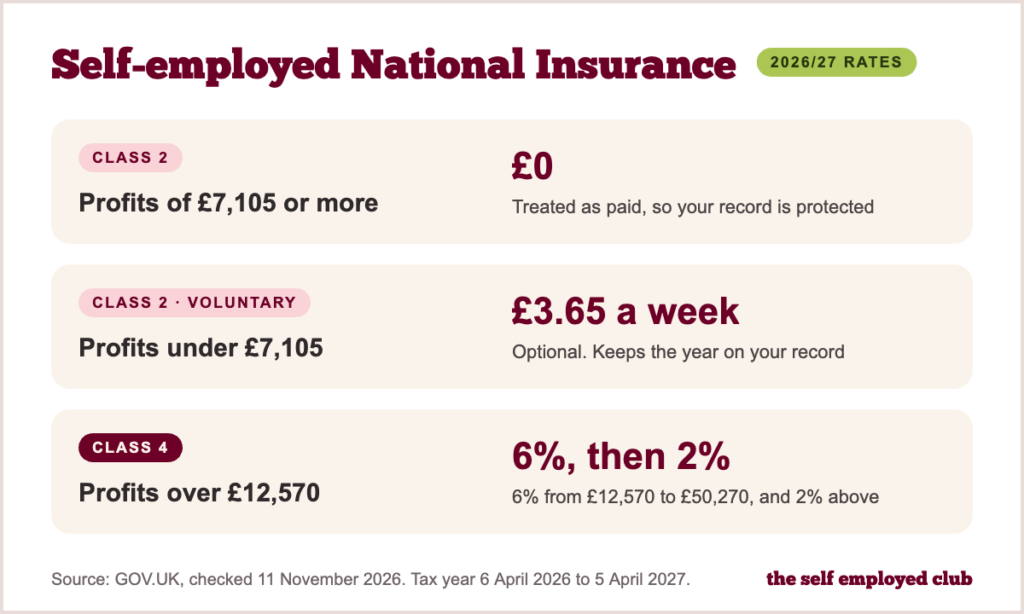
| Class 2 | Profits of £7,105 or more | Nothing. It’s treated as paid, so your record is protected |
| Class 2 (voluntary) | Profits under £7,105 | Nothing, unless you choose to pay £3.65 a week |
| Class 4 | Profits over £12,570 | 6% on profits from £12,570 to £50,270, then 2% above £50,270 |
Source: GOV.UK, Self-employed National Insurance rates. The 2026/27 tax year runs from 6 April 2026 to 5 April 2027.
Class 2: You Probably Don’t Pay It Any More
Class 2 used to be a flat weekly charge that every self-employed person paid. That has changed.
- Profits of £7,105 or more: you don’t pay Class 2. HMRC treats it as paid, so the year still counts on your National Insurance record.
- Profits under £7,105: you don’t have to pay anything, but the year won’t count on your record unless you choose to pay Class 2 voluntarily, at £3.65 a week (£189.80 for the year).
That voluntary payment is worth knowing about. It’s far cheaper than the other way of filling a gap, Class 3, which costs £18.40 a week (£956.80 for the year).
Class 4: The One You Actually Pay
Class 4 is a percentage of your profits, worked out on your tax return:
- Nothing on the first £12,570 of profit
- 6% on profits from £12,570 to £50,270
- 2% on profits above £50,270
Two things catch people out. Class 4 is on your profit, so claiming your allowable expenses reduces it. And Class 4 doesn’t count towards your State Pension or any benefits. It’s Class 2, paid or treated as paid, that builds your record.
How Much National Insurance Will You Pay?
Some examples for 2026/27:
| Your profit | Class 2 | Class 4 | National Insurance for the year |
|---|---|---|---|
| £5,000 | Not due (voluntary: £189.80) | £0 | £0, or £189.80 if you choose to pay |
| £10,000 | Treated as paid | £0 | £0 |
| £30,000 | Treated as paid | 6% of £17,430 | £1,045.80 |
| £60,000 | Treated as paid | 6% of £37,700, plus 2% of £9,730 | £2,456.60 |
Income Tax comes on top of this. To see both together, try our how much should I save for tax guide, or read how self-employed tax works.
To see your own National Insurance and income tax together, use our sole trader tax calculator. To keep track through the year, use our free bookkeeping spreadsheet.
Free income & expenses tracker
Our 2026/27 bookkeeping spreadsheet adds up your income and expenses and estimates your tax as you go. Plus a free allowable expenses cheat sheet. Tell us where to send it.
We’ll email you to confirm, then send the tracker. You’ll also get our Friday deals email for the self-employed. Unsubscribe any time. Privacy Policy
How to Pay National Insurance When Self-Employed
You don’t pay it weekly or monthly. It’s calculated on your Self Assessment tax return and paid with your Income Tax:
- Register as self-employed with HMRC if you haven’t already. Here’s how to register.
- File your tax return after the tax year ends. HMRC works out your Class 4 from your profit.
- Pay by 31 January. Your National Insurance is part of the same bill as your Income Tax.
If your bill is over £1,000, HMRC will usually ask for payments on account towards next year. These include Class 4 National Insurance, which is why a first tax bill can feel much bigger than expected.
If you choose to pay Class 2 voluntarily, you can do that through your tax return too.
If You’re Employed and Self-Employed
Lots of people have a job and a side business. In that case you pay both kinds:
- Class 1 on your wages, taken by your employer through PAYE
- Class 4 on your self-employed profits, through your tax return
How much you pay depends on your wages and your profits combined. HMRC tells you what’s due after you’ve filed your return.
What Your National Insurance Contributions Pay For
When you’re self-employed, Class 2 (paid or treated as paid) counts towards:
- The State Pension
- Maternity Allowance
- Contribution-based Employment and Support Allowance
- Bereavement Support Payment
It doesn’t count towards New Style Jobseeker’s Allowance. That’s one of the gaps in the safety net when you work for yourself.
For the State Pension, you need at least 10 qualifying years on your record to get anything, and the more years you have, the more you get. Each year your profits are £7,105 or more counts as one. This is one reason a private pension matters too.
Low-Profit Years: Check for Gaps
If your profits dip below £7,105, for example in your first year or a quiet one, that year won’t count unless you pay voluntary Class 2. You should:
- Check your National Insurance record on GOV.UK to see which years are full
- Check your State Pension forecast before paying, because not every gap needs filling
- Remember the deadline: you can usually only fill gaps from the past 6 years, by 5 April each year
After State Pension Age
You stop paying Class 4 from 6 April after you reach State Pension age. Class 2 is no longer treated as paid from that point either, because you don’t need it. You still pay Income Tax on your profits.
FAQs
Do self-employed people pay National Insurance?
Yes. If your profits are over £12,570 you pay Class 4 National Insurance at 6%, and 2% on profits above £50,270. It’s paid through your Self Assessment tax return.
How much National Insurance do I pay if I’m self-employed?
In 2026/27 you pay nothing on the first £12,570 of profit, 6% from £12,570 to £50,270, and 2% above that. On a profit of £30,000 that comes to £1,045.80.
Do I still have to pay Class 2 National Insurance?
Not if your profits are £7,105 or more: it’s treated as paid. If your profits are lower, paying is voluntary, at £3.65 a week, and it keeps that year on your National Insurance record.
How do I pay National Insurance when I’m self-employed?
Through Self Assessment. HMRC works it out from the profit on your tax return and you pay it with your Income Tax by 31 January. If you make payments on account, they include Class 4.
Do I pay National Insurance on a side hustle if I already have a job?
Yes, if your self-employed profits are over £12,570. You pay Class 1 on your wages through your employer and Class 4 on your profits through your tax return. HMRC works out the total after you file.

About the Author
Anita Forrest
Chief Deal Hunter
Anita is a Chartered Accountant, self-employed business owner and the person behind The Self Employed Club. She created the Club to help UK self-employed people spend less and keep more of what they earn, by bringing useful deals for their business and everyday life together in one place.
She writes about the things you actually need to know when you work for yourself, in the way she would want someone to explain them to her - clearly, simply and without the usual business waffle.

Join the Club — it's completely free
Members get handpicked deals and discounts on the tools, services and everyday essentials UK self-employed people actually use. Free to join, no catch.