This free bookkeeping spreadsheet records your income and expenses, adds them up and estimates your tax for 2026/27. It is built for UK sole traders. Below you will find what is in it, how to use it and which records you have to keep.
Free bookkeeping spreadsheet
Our 2026/27 income and expenses tracker adds up your figures and estimates your tax as you go. Plus a free allowable expenses cheat sheet. Tell us where to send it.
We’ll email you to confirm, then send the spreadsheet. You’ll also get our Friday deals email for the self-employed. Unsubscribe any time. Privacy Policy
What is in the bookkeeping spreadsheet
It is one Excel file with four tabs:
- Sheet Setup. You fill this in once: your details and any other earnings, such as wages from a job.
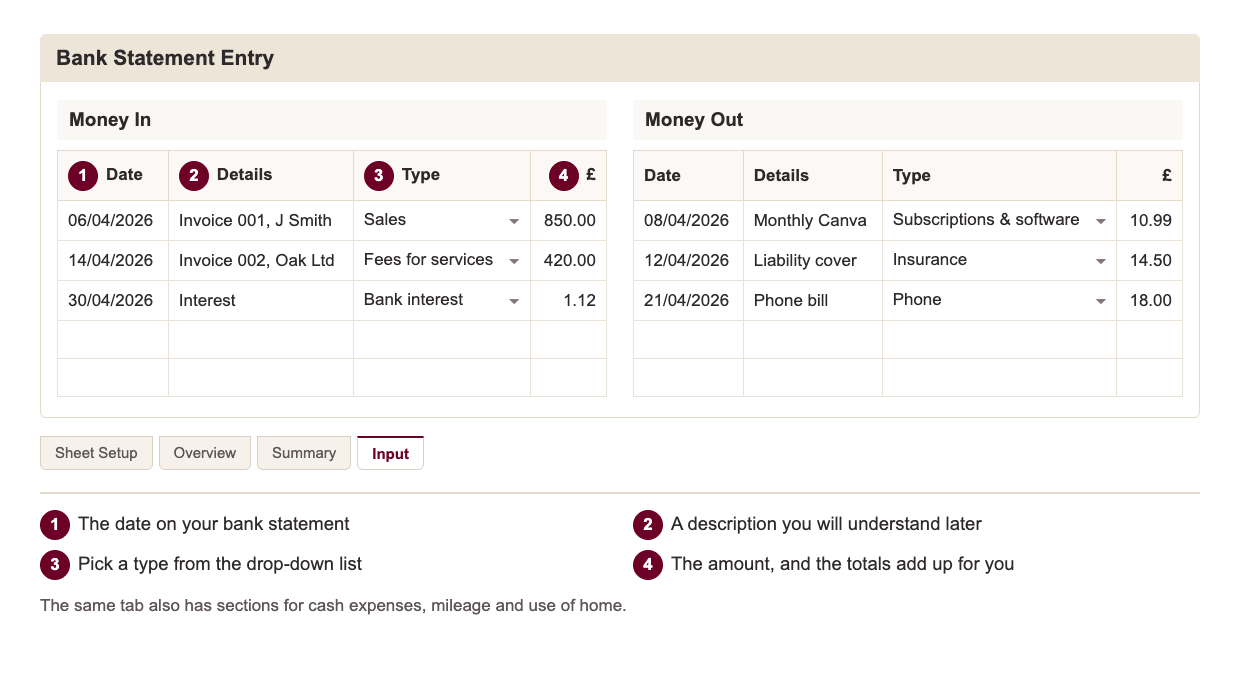
- Input. Where you record what comes in and goes out of your bank account: the date, a description, the amount and a type from a drop-down list. It also has sections for cash expenses, mileage and use of home.
- Summary. Your income and expenses added up for you. You do not type anything here.
- Overview. Your profit and an estimate of your Income Tax and National Insurance for the year.
It works best in Excel 365 or Excel 2021 onwards. Older versions may show errors on the Summary tab.
A simple bookkeeping spreadsheet, on purpose
Bookkeeping for sole traders does not need to be complicated. You need to know what came in, what went out and what is left. This spreadsheet does that and nothing more.
This self employed spreadsheet is for sole traders, not limited companies. The tax estimate uses the rates for England, Wales and Northern Ireland.
How to use it: bookkeeping for sole traders in four steps
- Set it up once. Fill in the Sheet Setup tab and leave it.
- Record what comes in and goes out. Once a week is good. Once a month is the minimum. Write a description you will understand in six months: “Monthly Canva subscription” beats “Canva”.
- Keep it to business. Personal spending does not belong in it. As a general rule, an expense needs to be wholly and exclusively for your business. Our allowable expenses list shows what counts.
- Check your numbers. The Summary and Overview tabs update on their own. Use the tax estimate to decide how much to set aside.
The tax figure is a planning guide, not a formal calculation. Your official figures come from your Self Assessment tax return. For a second view, try our sole trader tax calculator.
What records do you have to keep?
GOV.UK says that if you are self-employed you must keep records of:
- all sales and income
- all business expenses
- VAT records, if you are registered for VAT
- PAYE records, if you employ people
- records about your personal income
You also need proof, such as receipts for goods and stock, bank statements, sales invoices, till rolls and bank slips. Photos and scans are fine.
Keep your records for at least 5 years after the 31 January deadline for that tax year.
Source: GOV.UK, Business records if you’re self-employed (checked 12 November 2026).
Bookkeeping spreadsheet or software?
A spreadsheet is a good place to start. It costs nothing and it shows you how your numbers fit together.
Two things can change that. The first is volume: once you have a lot of transactions, software that reads your bank feed saves time. The second is Making Tax Digital for Income Tax. If it applies to you, you need software that works with it. It started on 6 April 2026 for people with qualifying income over £50,000, and applies from 6 April 2027 if your income was over £30,000.
The Self Employed Club is a deals website for self-employed people. Members get deals on accounting software, banking, insurance and everyday costs. It is free to join.
Three habits that keep bookkeeping painless
- Pick a day. Ten minutes every Friday beats a weekend in January.
- Use a separate bank account. When only business money goes through it, your records are easy to check. See our guide to free business bank accounts.
- Photograph receipts the day you get them. Then the paper can go.

Join the Club — it’s completely free
Members get handpicked deals and discounts on the tools, services and everyday essentials UK self-employed people actually use. Free to join, no catch.
Bookkeeping spreadsheet FAQs
Is the bookkeeping spreadsheet really free?
Yes. You give us your email address and we send it to you. You also join our Friday deals email, which you can leave at any time.
Can I do my bookkeeping on a spreadsheet as a sole trader?
Yes, unless Making Tax Digital for Income Tax applies to you. In that case you need software that works with it.
Does the spreadsheet work out my tax?
It gives you an estimate of your Income Tax and National Insurance for 2026/27, to help you plan. It is not a formal tax calculation.
Which version of Excel do I need?
It works best in Excel 365 or Excel 2021 onwards. Older versions may show errors on the Summary tab.
How often should I update my bookkeeping?
Once a week is good. Once a month is the minimum.
Read more: Self Assessment tax return for sole traders · Allowable expenses · Sole trader invoice template · Mileage log · Setting up as a sole trader
This guide is general information, not tax or legal advice.

About the Author
Anita Forrest
Chief Deal Hunter
Anita is a Chartered Accountant, self-employed business owner and the person behind The Self Employed Club. She created the Club to help UK self-employed people spend less and keep more of what they earn, by bringing useful deals for their business and everyday life together in one place.
She writes about the things you actually need to know when you work for yourself, in the way she would want someone to explain them to her - clearly, simply and without the usual business waffle.
Join the Club — it's completely free
Members get handpicked deals and discounts on the tools, services and everyday essentials UK self-employed people actually use. Free to join, no catch.