A virtual office address is a real street address you pay to use for your business, without working there. Your post goes to it and is scanned or forwarded to you. Sole traders use one to keep a home address off invoices and websites. Limited companies use one as the registered office address that the law requires, so a home address stays off the public register.
Which type you need depends on how your business is set up, so this guide is split in two: one part if you are a sole trader, one if you run (or are about to set up) a limited company.
Some links in this guide are affiliate links. If you buy through them the Club may earn a commission. It doesn’t change your price.
Table of Contents

Join the Club — it’s completely free
Members get handpicked deals and discounts on the tools, services and everyday essentials UK self-employed people actually use. Free to join, no catch.
The three types of virtual business address
“Virtual office address” covers three different services. Providers sell them separately, and buying the wrong one is the most common mistake.
| Address | What it is for | Who needs it | Public? |
|---|---|---|---|
| Business address | Everyday post from customers, suppliers and banks. The address on your website and invoices. | Optional for everyone | Only where you choose to show it |
| Registered office address | The official address of a limited company. Companies House and HMRC write to it. | Every limited company and LLP, by law | Yes, on the Companies House register |
| Service address | The official address of a director, company secretary or person with significant control. | Every company officer, by law | Yes, on the Companies House register |
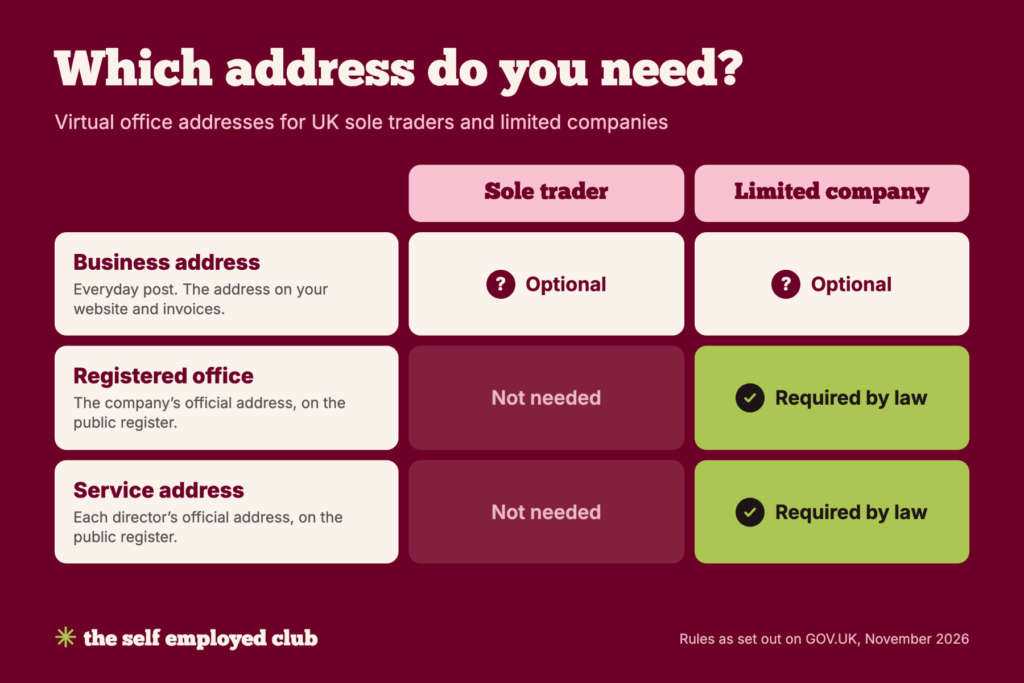
A sole trader only ever needs the first one. A limited company needs the second and third, and may want the first as well. Not sure which you are, or should be? See Sole Trader vs Limited Company.
Virtual business address for sole traders
Sole traders aren’t on the Companies House register, so there is no registered office to provide. The question is simply which address you put in front of customers.
Do sole traders need a business address?
You need an address, but it doesn’t have to be a separate one. GOV.UK says an invoice must include your business name, address and contact information. If you trade under a business name, it must also show your own name and “an address where any legal documents can be delivered to you”. For most sole traders working from home, that address is their home. (Our sole trader invoice template has a space for it.)
When a sole trader business address is worth paying for
- You don’t want your home address on invoices, your website or your email footer.
- You see clients’ details and would rather they didn’t have yours.
- You move often, or rent, and want one address that stays the same.
- You want business post kept apart from personal post.
If none of those apply, you don’t need one. It is a privacy and convenience purchase, not a legal requirement.
For me, the appeal is simple. It keeps your personal details private. It gives you an address you’re happy to put on your website, which anyone can see. And it’s a great perk having your post go somewhere that opens it, scans it and emails it over to you.
Registered office address for limited companies
Every limited company must have a registered office address, and it is shown on the public Companies House register for anyone to look up. GOV.UK’s rules are:
- It must be a physical address in the UK, in the same country the company is registered in.
- It must be an “appropriate” address, meaning post sent there will reach someone acting for the company and delivery can be confirmed.
- You can no longer use a PO Box.
- If you use your accountant’s or solicitor’s address, you need their permission first.
You can use your home address. GOV.UK’s own advice is not to if you want to keep it private, because it will be publicly available on the register. That is the main reason one-person companies buy a registered office address service.
Service address for directors
Directors, company secretaries and people with significant control each need a service address too, and that is also on the public register. If you use a registered office service to keep your home address private but give your home as your service address, your home address is still public. You need both covered.
How much does a virtual office address cost?
Prices below are from the two providers we list, 1st Formations and Rapid Formations, on 20 November 2026. Both quote renewals plus VAT.
| Service | 1st Formations | Rapid Formations |
|---|---|---|
| Registered office address | £39 a year | £39 a year |
| Service address (per director) | £26 a year | £26 a year |
| Business address | £96 a year | £89 a year |
| Official government post | Scanned and emailed free | Scanned and emailed free |
| Business post | 50p per item scanned | 50p per item scanned |
| Items that can’t be scanned (bank cards, for example) | Royal Mail postage plus 15% | Royal Mail postage plus 15% |
Setting up a new limited company? A package is cheaper
If you haven’t formed your company yet, both providers bundle the addresses into a formation package, which costs far less than buying each address on its own in the first year:
- Rapid Formations Privacy Package: £14.99 plus the £100 Companies House fee. Includes the registered office, service address and business address.
- 1st Formations Privacy Package: £117.99 including the £100 Companies House fee. Includes the registered office, service address and business address for 12 months.
After the first year the addresses renew at the standard prices in the table above, so budget for that. Once the company exists, you’ll also need a business bank account and a few tools to run it.
What to check before you buy a virtual office address
- Which address you are buying. A business address can’t be used as a registered office, and the other way round. Both providers say so on their pages.
- The cost per item of post. The annual fee is not the whole cost. At 50p an item, 10 letters a month adds £60 a year.
- The renewal price. Package prices cover the first year only.
- Whether it suits a sole trader. Both providers describe their business address service in terms of companies. If you are a sole trader with no company, ask before you buy.
- Parcels and size limits. These are post-handling services, not somewhere to have stock delivered.
- Who you have told. When you switch, update your website, invoices, bank and, for a company, Companies House.
Frequently asked questions
What is a virtual office address?
A real street address you pay to use for your business without working there. Post sent to it is scanned and emailed or forwarded to you.
Can I use my home address for my business?
Yes. Sole traders can put their home address on invoices, and a limited company can use a director’s home as its registered office. For a company, the address will be on the public Companies House register.
Can I use a PO Box as my registered office address?
No. GOV.UK says a PO Box can no longer be used as a registered office address.
What is the difference between a registered office address and a service address?
The registered office is the company’s official address. A service address is the official address of an individual director, secretary or person with significant control. Both are public.
Is a virtual business address the same as a registered office?
No. A business address is for everyday post and isn’t recorded at Companies House. A registered office is a legal requirement for a company and receives official post.
Does a virtual office address have to be in London?
No. A registered office must be in the same UK country as the company’s registration, but not in any particular city. The two providers in this guide both use a London address.
The short version
- Sole trader: you don’t need one by law. Buy a business address only if you want your home address kept off your paperwork.
- Limited company: you must have a registered office and a service address. Use a service for both if you don’t want your home address on the public register.
- Forming a new company: a privacy package covers all three addresses for the first year for less than buying them one by one.
Want to Read More About Starting Out?
More guides like this are in Starting Out. A few to read next:

About the Author
Anita Forrest
Chief Deal Hunter
Anita is a Chartered Accountant, self-employed business owner and the person behind The Self Employed Club. She created the Club to help UK self-employed people spend less and keep more of what they earn, by bringing useful deals for their business and everyday life together in one place.
She writes about the things you actually need to know when you work for yourself, in the way she would want someone to explain them to her - clearly, simply and without the usual business waffle.
Join the Club — it's completely free
Members get handpicked deals and discounts on the tools, services and everyday essentials UK self-employed people actually use. Free to join, no catch.